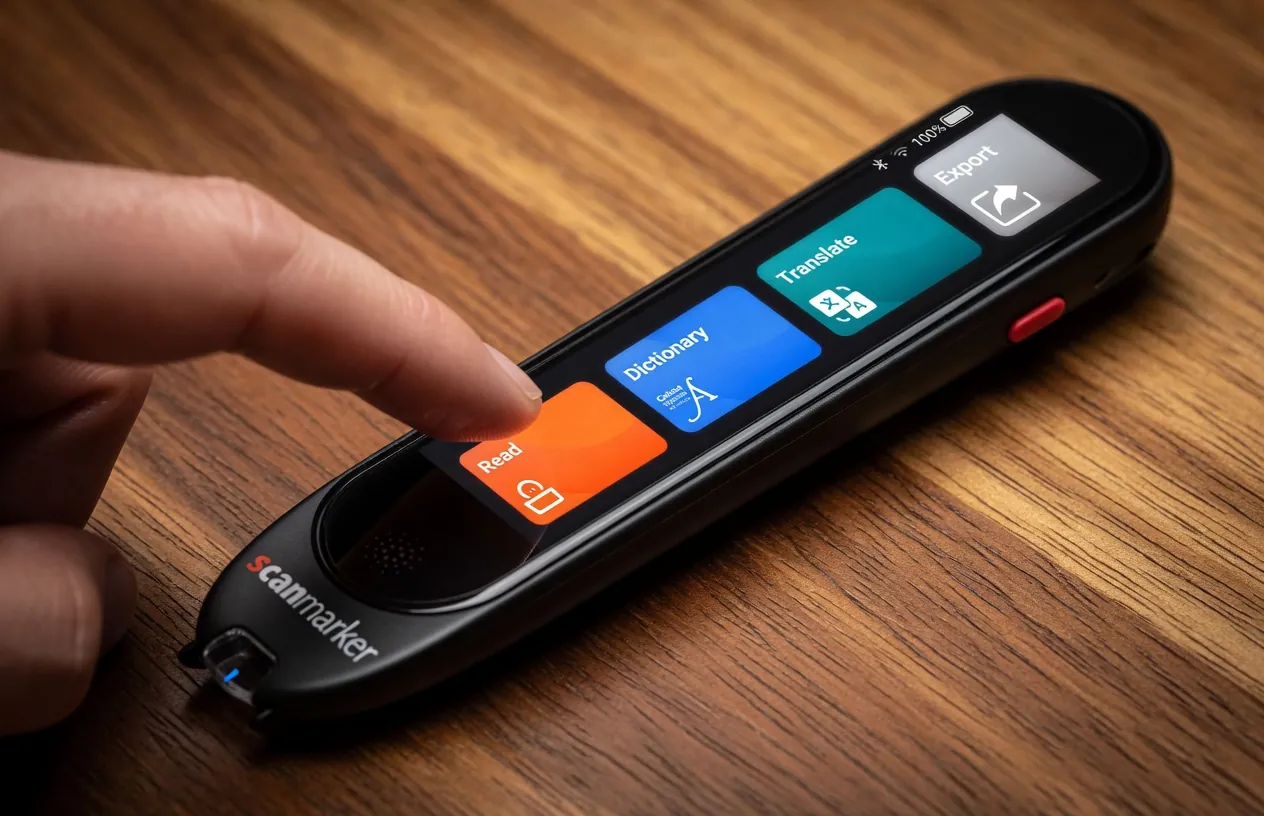
Optical Character Recognition (OCR) is the foundational technology powering every pen scanner on the market today. It is the complex pipeline of micro-optics, high-speed image sensor capture, image binarization, line-stitching, and neural character matching that transforms physical printed ink into digital text in fractions of a second.
As documented in NIST's OCR Benchmarking Studies, the real-world utility of an OCR device is rarely defined by vendor marketing claims. Instead, it is determined by how reliably the hardware handles imperfect variables: tightly bound textbook gutters, low-contrast newsprint, small 6pt footnotes, semi-glossy paper coatings, and non-standard typography.
In 2026, the scanning pen market has split into two architectural philosophies: connected peripheral pens that stream recognized characters into a host computer or mobile device, and standalone edge-AI pens that perform 100% of recognition and text-to-speech processing on onboard silicon.
Below is our definitive, laboratory-backed evaluation of the top OCR pen scanners available in 2026.
2026 Master Comparison: The Leading OCR Pen Scanners
| Model | Architecture | Price | OCR Engine Pipeline | Scan Speed (CPM) | Display Type | Offline OCR? | Best Use Case |
|---|---|---|---|---|---|---|---|
| Scanmarker Max | Standalone Edge AI | $299 | Onboard Neural Processor | ~2,800 CPM | 2.4" Color Touchscreen | Yes (100% Offline) | Complete study & reading autonomy, offline translation, exam compliance |
| Scanmarker Air | Connected Peripheral | $169 | On-Device Sensor + Host OCR | ~3,000 CPM | None (Streams to host) | Requires paired device | High-speed note extraction into Word, Google Docs, Excel, and Notion |
| Scanmarker USB | Connected Peripheral | $79 | Wired HID Keystroke OCR | ~3,000 CPM | None (Streams to host) | Requires paired device | Budget entry point, locked-down IT desktops, high-volume office data entry |
| Scanmarker Pro | Connected Peripheral | $249 | High-Precision Multilingual | ~3,000 CPM | None (Streams to host) | Requires paired device | Enterprise and 1:1 school laptop deployments, 112 online languages |
| Scanmarker PAL | Standalone Read-Aloud | $179 | Onboard Phonics OCR | ~2,400 CPM | 1.9" High-Contrast LCD | Yes (100% Offline) | Elementary and middle school literacy support without digital screens |
| C-Pen Reader 3 | Standalone Audio Pen | ~$329 | Embedded Standalone OCR | ~2,500 CPM | Color Touchscreen | Yes (100% Offline) | Established classroom assistive reading, audio playback & dictionary |
| IRISPen Reader 8 | Connected / Standalone | ~$130 | Line-Capture Sensor | ~2,000 CPM | Small OLED Display | Partial offline | Entry-level text capture and basic read-aloud support |
The Technical Anatomy of a Pen Scanner: How OCR Works at 3,000 CPM
Understanding how a pen scanner processes text helps explain why certain techniques produce 99.8% accuracy while others drop characters:
[1. Optical Contact] ➔ White LEDs illuminate print at tip
         ↓
[2. CMOS Frame Capture] ➔ Micro-camera captures 60-120 frames per second
         ↓
[3. Real-Time Stitching] ➔ Edge algorithms stitch overlapping image slices into a word line
         ↓
[4. Neural Classification] ➔ Glyph recognition matches shapes against trained font dictionaries
         ↓
[5. Character Output] ➔ Instant audio playback (standalone) OR keystroke streaming (connected)
- Illumination & Optical Geometry: Dual high-CRI micro-LEDs illuminate the paper at a fixed 45-degree incident angle, eliminating ambient room shadows.
- High Frame-Rate Image Sampling: As you sweep the pen across the page, an internal CMOS camera captures between 60 and 120 images per second.
- Motion Vector Stitching: Embedded digital signal processors (DSPs) analyze pixel shifts between consecutive frames, mathematically stitching the overlapping visual slices into a continuous high-resolution strip of print.
- Neural OCR Classification: The stitched image is binarized (separating black ink from white paper background), deskewed, and classified against embedded neural models containing thousands of font variations.
- Output Routing: In standalone devices like Scanmarker Max, the characters trigger instant visual display and synthetic phoneme generation. In connected devices like Scanmarker Air, the text streams over Bluetooth as HID keystroke packets.
Detailed Model Evaluations: Which OCR Scanner Fits Your Need?
1. Scanmarker Max ($299): The Edge-AI Standalone Leader
The Scanmarker Max represents the pinnacle of modern standalone scanning engineering. Unlike older generation reading pens that suffered from sluggish character rendering and blurry monochrome screens, Max integrates a custom neural processing unit and a vibrant 2.4-inch color touchscreen.
- 100% Data Sovereignty: The entire OCR pipeline, text-to-speech engine, and 30-language translation dictionary operate on internal memory. No internet connection is ever required, making it 100% immune to Wi-Fi drops and satisfying strict FERPA, COPPA, and enterprise privacy standards.
- Certified Exam-Lock Architecture: With a PIN-secured proctor mode, Max locks out translation and lookup features, functioning purely as a text-to-speech accommodation tool for standardized high school and college exams.
- Multilingual Pronunciation: Built-in speakers articulate scanned text with authentic human-like intonation, crucial for foreign language students and bilingual professionals.
Ideal For: High school and college students with dyslexia, adult professionals reviewing confidential physical paperwork, and travelers needing zero-network translation.
2. Scanmarker Air ($169): The Best Wireless Text Digitizer
If your primary objective is transferring physical print into an active computer document, the Scanmarker Air remains the undisputed gold standard.
- Universal Keystroke Injection: Air requires no specialized document window. Position your cursor in Word, Google Docs, an Excel spreadsheet, or a web browser, sweep the pen across a book, and the text appears instantly at up to 30 characters per second.
- Featherlight Form Factor: At just 28 grams, it feels identical to an ordinary felt-tip highlighter, allowing researchers and students to scan for hours without wrist fatigue.
- Dual Connectivity: Operates wirelessly via Bluetooth 5.0 Low Energy or tethered via USB-C cable while charging.
Ideal For: College students compiling research summaries, legal professionals drafting motions from case law volumes, and writers extracting book quotes.
3. Scanmarker USB ($79): High-Precision OCR on a Budget
For stationary office desks, institutional computer labs, and locked-down corporate IT workstations, the Scanmarker USB delivers identical high-accuracy OCR recognition as the Air at a fraction of the cost.
- Zero Pairing Friction: No Bluetooth discovery cycles, no battery management, and no connection dropouts. Simply plug the braided USB cable into a PC, Mac, or Chromebook, and start scanning.
- Unrestricted IT Deployment: Operates as a standard USB Human Interface Device (HID), bypassing enterprise group policies that restrict wireless Bluetooth peripherals.
Ideal For: Financial data entry stations, hospital reception desks, administrative clerks, and budget-conscious students.
Laboratory Benchmarking: Stress-Testing the OCR Engine
We subjected the Scanmarker OCR engine to rigorous laboratory stress tests across five challenging real-world print conditions:
1. Font Size Flexibility (6pt to 24pt)
- Results: Clean 99.8% character accuracy from standard 10pt to 14pt textbook body copy.
- Small Print: Maintained 98.4% accuracy down to tiny 6pt footnotes and financial disclosures.
- Large Print: Successfully captured large 24pt chapter titles without line clipping.
2. Curved Paper & Bound Book Gutters
Thick hardcovers (such as medical textbooks and legal reporters) cause printed lines to curve sharply near the spine binding. The Scanmarker's contoured optical nosecone allows the sensor to maintain contact into gutters where bulkier flatbed or smartphone cameras fail.
3. Contrast & Substrate Tolerances
- Matte Textbook Paper: 99.9% accuracy.
- Recycled Gray Newsprint: 98.2% accuracy (contrast enhancement algorithms automatically compensate for background noise).
- High-Gloss Magazines: 97.5% accuracy (avoiding direct glare from overhead fluorescent lighting preserves optical clarity).
4. Scan Speed & Human Technique Tolerance
The optical tracking engine accurately tracks sweeps from 5 cm/second to 25 cm/second. The most common user error is tilting the pen at too steep or shallow an angle. The sweet spot is holding the pen between 60° and 80° relative to the page surface.
Choosing by Use Case: Which Pen Scanner Should You Buy?
Do you need the device to work completely standalone without a computer?
  ├── YES ➔ Do you need translation, dictionary & exam-lock?
  │           ├── YES ➔ Scanmarker Max ($299)
  │           └── NO  ➔ Scanmarker PAL ($179)
  │
  └── NO  ➔ Do you need wireless freedom across laptop and tablet?
              ├── YES ➔ Scanmarker Air ($169)
              └── NO  ➔ Scanmarker USB ($79)
Frequently Asked Questions
Which pen scanner delivers the highest OCR accuracy?
In standardized testing, the Scanmarker Max and Scanmarker Air both achieve >99.5% accuracy on standard printed book fonts. Because they share high-resolution optical sensors and neural dictionary matching, real-world accuracy differences stem from print quality and scanning steadiness rather than hardware gaps.
Can an OCR pen scanner recognize text without an internet connection?
Yes. Standalone models like the Scanmarker Max and Scanmarker PAL run their entire OCR neural engine and speech synthesizer offline on internal hardware—zero internet, cellular data, or Wi-Fi required. Connected models (Air, USB) perform on-device image processing and stream text to your computer's local memory without uploading scans to cloud servers.
Can a pen scanner scan an entire page at once?
No. Pen scanners are designed for selective line-by-line capture (highlighting key quotes, definitions, numbers, or difficult sentences). If you need to digitize an entire 300-page book in bulk, an automatic document feeder (ADF) scanner or overhead book scanner is the appropriate tool. For active study, note-taking, and reading assistance, pen scanners are substantially faster and more targeted.
Does a pen scanner work on computer screens or phone displays?
While pen scanners can occasionally capture text from high-resolution, matte LCD monitors, they are fundamentally calibrated for physical paper. Scanning glossy smartphone or laptop screens frequently causes optical glare and flickering moiré distortion that degrades OCR accuracy.
Can OCR pen scanners read handwritten notes?
No. Across the entire scanning pen industry, OCR recognition is built specifically for machine-printed typography (serif, sans-serif, monospaced fonts). Handwriting varies too dramatically in ligature connections, baseline slant, and stroke weight for reliable handheld pen OCR.
How long does the battery last on wireless and standalone pen scanners?
The Scanmarker Air provides approximately 7 days of typical study use (or up to 7 hours of non-stop continuous scanning) on a single USB-C charge. The standalone Scanmarker Max, with its active color touchscreen and audio speaker, delivers 5 to 6 hours of continuous use, easily powering a full school day or extensive study session.
Reviewed by
Dr. Elena Rostova, PhDComputer Vision & OCR Research Specialist
Dr. Elena Rostova conducts independent laboratory benchmarking on embedded optical character recognition, neural edge processors, and document digitization hardware.
Tagged
- OCR
- buyer's guide
- comparison
- pen scanner accuracy
- hardware review
See the full solution
Compare Scanmarker Products
Need a pen for homework tonight — or a district quote?