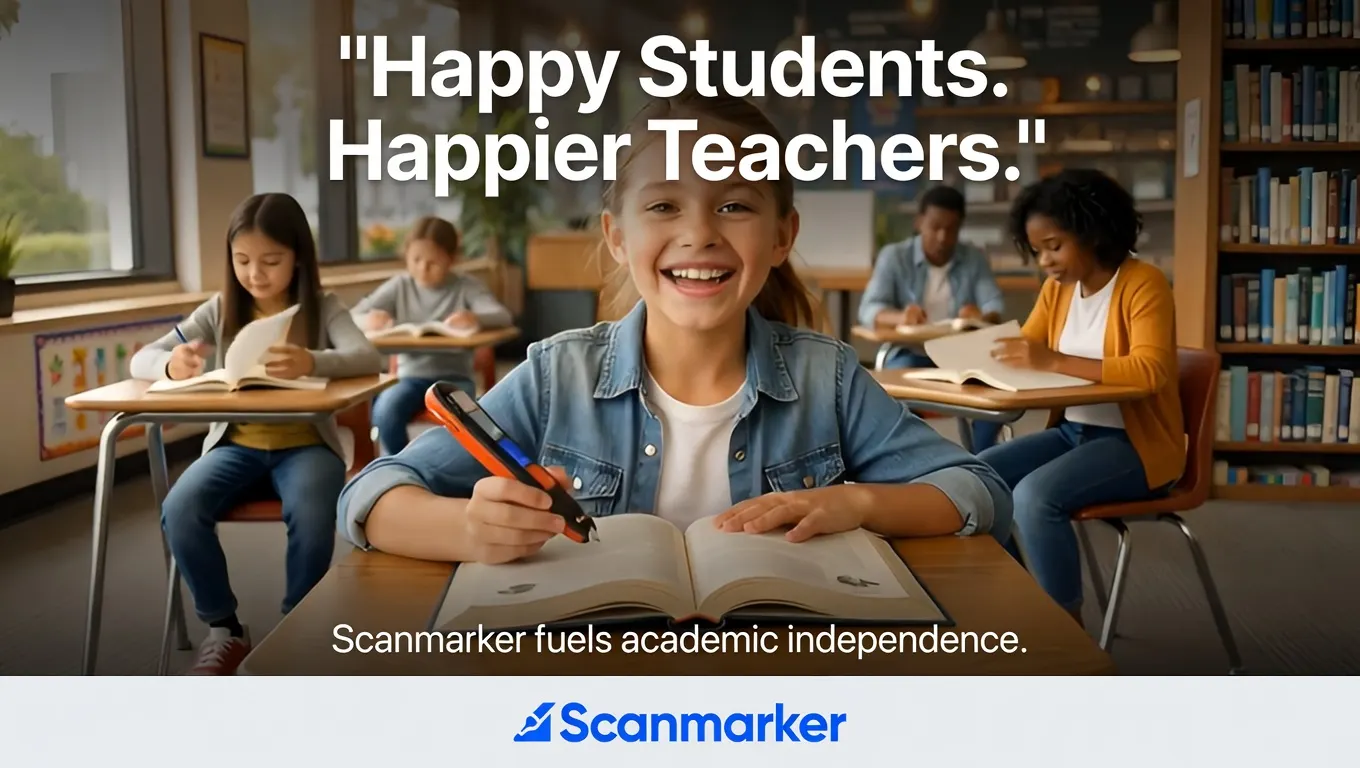
If you're a teacher, reading specialist, or SLP implementing the Science of Reading in your school or district, you've probably had this question arrive in some form: does a reading pen support what we're doing, or does it get in the way?
It's a good question, and it deserves a careful answer — not the marketing version and not the reflexive skepticism version.
The short answer: a reading pen supports a Science of Reading classroom when used correctly, and conflicts with it when it isn't. The difference is in the protocol, not the device.
Here's the full version, including what the research actually says, where the line is, and how to write that line into your classroom practice.
What the Science of Reading Actually Says (Brief Version)
"Science of Reading" is a broad term covering the body of research on how reading develops and what makes reading instruction effective. For the purposes of this article, the most relevant framework is the Simple View of Reading, developed by Gough and Tunmer (1986) and extensively replicated since:
Reading Comprehension = Decoding × Language Comprehension
Both variables matter, and both must be non-zero for reading to work. A student with strong language comprehension but impaired decoding (the dyslexia profile) will struggle to read even if they understand spoken language well. A student with strong decoding but weak language comprehension (often seen in early ELL learners) can "read" words accurately but not understand what they're reading.
What "Structured Literacy" Means in Practice
Structured literacy is the instructional approach consistent with the Science of Reading. It emphasizes:
- Explicit phonemic awareness instruction — the ability to hear and manipulate individual sounds in spoken language
- Systematic phonics — letter-sound correspondences taught in a deliberate, cumulative sequence
- Fluency development — accurate, automatic word recognition that allows cognitive resources to shift to comprehension
- Vocabulary instruction — building the word knowledge that supports language comprehension
- Reading comprehension strategies — explicit instruction in making meaning from text
What structured literacy does not include: guessing from context, three-cueing, and whole-language approaches that were widely used in earlier decades and have not been supported by the research base.
What Has Nothing to Do with a Reading Pen
The Science of Reading is a framework for teaching reading. A reading pen is a tool for accessing printed text. These are different activities, and a reading pen is not a reading intervention — it has nothing to do with teaching phonemic awareness, phonics, fluency, or comprehension strategy use.
This distinction is not a minor one. Conflating the two creates the risk of using an access tool in a context designed for skill acquisition — which undermines the instruction.
Reading Pens Are Access Tools, Not Reading Interventions
What That Distinction Actually Means
An intervention changes something: it teaches a skill, builds a neurological pathway, addresses the underlying cause of a difficulty.
An access tool provides a workaround for a barrier: it allows a person to participate in an activity despite a limitation, without addressing the underlying cause of that limitation.
A wheelchair is an access tool, not a physical therapy intervention. Glasses are an access tool, not vision training. A reading pen is an access tool, not a reading intervention.
The difference matters for three reasons:
-
It sets appropriate expectations. A student who uses a reading pen will not, by virtue of using it, become a better reader. Phonics instruction does that. The pen is for the content access problem, not the reading skill problem.
-
It protects the integrity of interventions. If a reading pen is used during phonics practice time, it bypasses the very skill-building process the intervention is designed to deliver. This is the context in which a reading pen genuinely conflicts with the Science of Reading.
-
It informs documentation. In an IEP or 504, a reading pen belongs under "assistive technology accommodations," not under "specially designed instruction" or "reading intervention services." These are separate sections for a reason.
The "Attempted Decoding First" Protocol
Many reading specialists and SLPs who integrate reading pens into a Science of Reading classroom use a simple, effective protocol:
The student attempts to decode the word first. If they can't after a reasonable try (typically 3–5 seconds), they scan it with the pen.
This preserves the phonics practice loop — the student is still trying to apply decoding skills — while removing the barrier of being permanently stuck on a single word, which can derail comprehension and disengage the reader entirely.
The protocol works best when it's explained to the student explicitly: "The pen is for when you've tried and you're stuck. It's not for skipping the try." For many students, this framing lands naturally once they understand why.
Where a Reading Pen Supports a Science of Reading Classroom
Content-Area Learning While Phonics Instruction Catches Up
The most common and defensible use case: a student in Tier 2 or Tier 3 phonics intervention is simultaneously in your mainstream science, social studies, or math classroom, where grade-level content is being delivered through printed text.
Without an accommodation, this student faces two simultaneous losses: they fall behind in reading skills (because intervention is slow and takes time) and they fall behind in content knowledge (because they can't access the grade-level text while their reading catches up). The reading pen breaks the second loss without affecting the first. The intervention continues independently; the pen supports independent content access.
This is the correct application: the pen and the intervention run in parallel, addressing different problems.
Preserving Comprehension Gains While Decoding Lags
Under the Simple View of Reading, decoding and language comprehension are separate. A student with strong language comprehension but weak decoding has an asset — good listening comprehension — that a reading pen can engage. By converting printed text to audio, the pen allows the student to use their language comprehension strengths on grade-level material even before their decoding has caught up.
This matters for long-term reading development because vocabulary and background knowledge, built through exposure to grade-level content, later accelerate reading comprehension once decoding is in place. Preventing a comprehension gap is part of the intervention, even when the tool doing it isn't an intervention tool.
Independent Practice Without an Adult Reader in the Room
In a structured literacy classroom, independent practice time is valuable — students need to apply what they're learning without the teacher present for every word. For a student with significant decoding difficulty, independent practice without any support collapses into frustration and avoidance, not practice.
A reading pen in the student's hands during independent work time converts that collapse point into actual practice time: the student reads, tries to decode, uses the pen when genuinely stuck, and keeps moving through the text. The practice is imperfect — but it's happening, which is better than the alternative.
Where a Reading Pen Can Conflict with SoR Goals
If It Becomes a Phonics Bypass Rather Than a Bridge
If a student reaches for the pen every time they encounter an unfamiliar word — before making any decoding attempt — the pen is actively undermining phonics instruction by making the decoding attempt feel unnecessary.
This is the misuse pattern, and it develops naturally when the protocol isn't established clearly or the student hasn't internalized why the "try first" step matters.
Signs of this pattern in a classroom setting:
- The student scans words that are within their phonetic knowledge (single-syllable words they've been taught)
- Phonics assessment scores don't improve despite ongoing intervention
- The student expresses preference for "just scanning everything" rather than trying to read independently
Protocols That Keep It Supportive
In phonics instruction settings: The pen should not be present during direct phonics instruction or decodable text reading practice, unless the IEP specifically addresses this and the reading specialist has signed off on it. During this time, the student is practicing decoding — the pen bypasses that practice.
In independent reading settings: The "try first" protocol. Clearly established, consistently followed.
In content-area classroom settings: More open use is appropriate here — the goal is content comprehension, not decoding practice. The student may use the pen freely on science worksheets or social studies readings where the instructional goal is content, not phonics skill.
When in doubt: Talk to the reading specialist or SLP who is delivering the intervention. They should be aware of how and when the pen is being used in general education settings so the two don't conflict.
MTSS: Which Tier Does a Reading Pen Belong In?
This is a question educators sometimes struggle with because MTSS is an instructional framework and a reading pen is an accommodation tool — they're categorically different things and don't map cleanly onto each other.
A practical way to think about it:
| MTSS Tier | What happens there | Role of reading pen |
|---|---|---|
| Tier 1 (universal instruction) | All students receive grade-level reading instruction using structured literacy principles | Pen available as accommodation for documented students; does not replace or alter Tier 1 instruction |
| Tier 2 (targeted intervention) | Small-group phonics intervention for students below benchmark | Pen is not used during intervention time (bypasses the skill practice); pen is used for content-area access between intervention sessions |
| Tier 3 (intensive intervention) | Individualized, intensive reading instruction for students significantly below benchmark | Same principle as Tier 2 — intervention time pen-free; content access time pen-available |
The reading pen lives in the accommodation layer that runs across all tiers, supporting content access while tiered instruction addresses the skill gap. It is not a Tier 1, 2, or 3 intervention itself.
What Reading Specialists and SLPs Actually Say
The consistent view from reading professionals who have integrated reading pens into evidence-based practice:
"It's a tool, not a treatment." The device supports access; the intervention builds skill. Keeping those categories clear in your own mind and in how you explain it to parents and students is the most important thing.
"Protocol matters more than the pen." A well-established "try first" protocol makes the pen a useful bridge. No protocol makes it a decoding bypass. The device itself is neutral — how it's used determines whether it supports or conflicts with your instructional goals.
"Coordinate between general ed and intervention." The reading specialist should know how the pen is being used in the general education classroom, and the general education teacher should know what phonics level the student is working at in intervention. These conversations don't happen automatically; someone has to initiate them.
For further reading on structured literacy and assistive technology integration, the International Dyslexia Association and the Reading League both maintain evidence-based resources for practitioners.
Frequently Asked Questions for Educators and Reading Interventionists
Does a reading pen fit with the Science of Reading?
Yes, when used correctly. A reading pen is an assistive technology tool that provides access to printed text — it does not teach phonemic awareness, phonics, or fluency. In a Science of Reading classroom, the pen functions as an accommodation that keeps a struggling decoder from falling behind in content-area subjects while targeted structured literacy instruction happens separately. Used this way, it supports rather than undermines the instructional model.
Will using a reading pen stop a student from making phonics progress?
Not if structured phonics instruction continues in a separate, pen-free setting. The risk is using the pen instead of phonics instruction, not alongside it. A student receiving Tier 2 phonics intervention in the morning and using a reading pen on a science worksheet in the afternoon is not undermining their progress — both activities are appropriate.
Should a student use a reading pen during phonics instruction time?
Generally no. During explicit phonics instruction and decodable text reading practice, the student is practicing decoding skills — the pen bypasses that practice. Use it for content-area tasks where the instructional goal is comprehension, not decoding.
How do I write reading pen use into a Science of Reading intervention plan?
Document it as a separate assistive technology accommodation — typically in the IEP's AT section or as a 504 accommodation — not within the specially designed reading instruction component. The intervention targets skill acquisition; the pen is an access support for settings where decoding barriers would otherwise prevent content learning.
Can a non-specialist teacher implement the "try first" protocol effectively?
Yes. The protocol is simple and consistent. The teacher doesn't need to assess phonics levels to implement it — they just need to reinforce the "you try first, then scan" expectation consistently and briefly explain why to the student. The reading specialist sets the expectation; the classroom teacher maintains it.
What's the right language to use with parents about a reading pen?
"It's an access tool — it helps [student's name] read printed material independently while the reading instruction we're providing builds the underlying skills." That framing correctly positions the pen and the intervention as working together, not as alternatives or redundant services.
Is there any research specifically on reading pens and reading skill development?
The research base specifically on reading pens and reading skill outcomes is limited — most of the evidence is on assistive technology for reading broadly and text-to-speech tools specifically. The International Literacy Association and the What Works Clearinghouse maintain accessible summaries of assistive technology research. For a deeper look at the distinction between assistive technology and reading instruction, the IDA's research briefs are a good starting point.
Recommended Reading
For educators who want to go deeper on the Science of Reading and its implications for assistive technology:
- Dehaene, S. — Reading in the Brain: The neuroscience of reading acquisition — the foundation for why phonics-based instruction works neurologically.
- IDA — Structured Literacy: Effective Instruction for Students with Dyslexia: The professional body's summary of what structured literacy means in practice.
- The Reading League — Science of Reading: Practitioner-facing resources for implementing SoR principles in schools.
- LETRS Professional Development: The dominant evidence-based professional development framework for Science of Reading implementation, widely adopted at district scale.
Related reading: A Teacher's Guide to Reading Pen Accommodations · Writing a Reading Pen Into an IEP or 504 Plan · Best Reading Pen for Dyslexia in 2026 · Reading Pens for Schools & Districts
Tagged
- Science of Reading
- structured literacy
- MTSS
- teachers
- reading specialists
- SLP
- assistive technology
- dyslexia
See the full solution
Scanmarker for Dyslexia & Reading Support
Need a pen for homework tonight — or a district quote?