If you have dyslexia or ADHD and you work in a role that involves reading printed documents — reports, contracts, printed meeting materials, forms — there's a good chance your employer is legally required to provide you with a reading pen if you ask.
That's not marketing language. That's the Americans with Disabilities Act.
Most adults with reading difficulties at work have never asked an employer to fund an accommodation, for a mix of understandable reasons: they don't know they're entitled to ask, they don't want to disclose a diagnosis, or they assume the company will say no. This guide walks through the actual process — what the law requires, what you say, what HR can and can't ask you, and what happens if they refuse.
The Short Version: Your Employer Probably Has to Pay for This
Under the ADA, employers with 15 or more employees are required to provide reasonable accommodations to employees with disabilities — unless doing so would create an undue hardship. A reading pen costs $179–$299. For virtually any employer above the 15-employee threshold, a single device at that price almost certainly does not constitute undue hardship.
If your dyslexia or ADHD substantially limits your ability to read printed materials in the course of your job, you have a functional limitation that the ADA was designed to address. A reading pen is a concrete, low-cost solution to that limitation.
The process for getting it isn't simple — it involves documentation, a conversation with HR, and a formal request — but it is navigable, and the legal framework is on your side.
Who This Applies To
Dyslexia as a Covered Disability Under the ADA
Dyslexia qualifies as a disability under the ADA when it substantially limits a major life activity. Reading is explicitly listed as a major life activity in the ADA Amendments Act of 2008. If dyslexia makes reading substantially more difficult for you than it is for most people, you meet the functional definition — regardless of whether you have a formal diagnosis on file.
The Equal Employment Opportunity Commission (EEOC) confirms that dyslexia and similar learning disabilities are typically covered. The standard is the functional limitation, not the diagnostic label.
ADHD as a Covered Disability Under the ADA
ADHD qualifies as a disability under the ADA when it substantially limits a major life activity — which includes reading, concentrating, and neurological function, all of which ADHD may affect. The ADA Amendments Act of 2008 explicitly broadened coverage to include conditions that affect executive function and concentration.
If ADHD significantly impairs your ability to read and process printed materials in a work context, you are likely covered.
Do You Have to Disclose Your Diagnosis?
No — not the specific diagnosis. What you need to communicate is the functional limitation: that you have a medical condition that affects your ability to read printed materials and that a specific accommodation (a reading pen) would address that limitation.
HR can ask for documentation from a medical professional confirming that you have a condition causing the functional limitation. They generally cannot demand that you name the specific diagnosis in the accommodation request meeting, and they cannot share information you do provide with your direct manager without your permission.
In practice, working with your doctor to get a brief letter confirming a reading-related limitation and recommending assistive technology is usually the smoothest path.
Step 1: Identify the Specific Work Tasks That Are Barriers
Before you submit a request, think concretely about where the reading limitation shows up in your job. The more specific you can be, the more clearly you can connect the accommodation to your actual work.
Examples:
- Reading printed contracts, reports, or compliance documents
- Following along with printed meeting agendas or reference materials
- Processing paper-based forms or physical intake documents
- Reading printed labels, signage, or physical materials in a production or field environment
You don't need to catalogue every moment reading is hard — you need to identify the job functions where the limitation creates a barrier that a reading pen would address. This becomes the basis of your accommodation request.
Step 2: Request the Accommodation in Writing
The ADA doesn't require a written request — but submitting one in writing creates a record, which matters if the process doesn't go smoothly.
Sample Accommodation Request Letter (Copy and Adapt)
[Your name] [Date]
To: [HR Manager's name or HR Department] Re: Request for Reasonable Accommodation
Dear [HR Manager or HR Department],
I am writing to formally request a reasonable accommodation under the Americans with Disabilities Act (ADA) for a disability that affects my ability to perform certain job functions.
I have a medical condition that substantially limits my ability to read printed text, which affects my performance on the following job duties: [briefly describe — e.g., "reviewing printed contracts and reports, reading physical meeting materials, and processing paper-based documentation"].
I am requesting the following accommodation: a handheld reading pen (specifically, a device such as the Scanmarker Pro or Scanmarker Max) that scans printed text and reads it aloud through an earphone. This device is available at a retail cost of approximately $[price] and would allow me to independently access and process the printed materials required in my role.
I am willing to provide documentation from my treating physician or other qualified professional confirming the functional limitation and supporting this accommodation request. Please let me know what documentation you require and the timeline for the interactive process.
I am available to meet at your convenience to discuss this request.
Sincerely, [Your name] [Job title] [Contact information]
What HR Can and Can't Ask You
They can:
- Ask for documentation from a medical professional confirming the functional limitation
- Ask clarifying questions about how the limitation affects your specific job duties
- Propose alternative accommodations that also address the limitation (you can accept or discuss)
- Request time to evaluate the request (they don't have to respond the same day)
They cannot:
- Require you to disclose your specific diagnosis beyond what's necessary to establish the functional limitation
- Share your medical information with your direct manager or coworkers without your permission
- Deny the request without engaging in the interactive process
- Retaliate against you for making an accommodation request
Step 3: The Interactive Process — What to Expect
Once HR receives your request, the ADA requires them to engage in an "interactive process" with you — a conversation about your needs, what accommodations would address them, and what's feasible. This isn't just a rubber stamp of your request; it's a legitimate back-and-forth.
What typically happens:
- HR acknowledges the request and sets up a meeting or requests documentation.
- You provide documentation from your doctor (a brief letter confirming the limitation is usually sufficient — full evaluation reports are typically not required).
- HR evaluates whether the requested accommodation — a reading pen — is effective and reasonable.
- They either approve the request, propose an alternative, or deny it.
The process should happen within a reasonable timeframe. What's "reasonable" isn't defined exactly in the ADA, but several weeks of unexplained delay is worth following up on, in writing.
If HR proposes an alternative accommodation — for example, providing all documents in digital format so you can use free software — consider whether it actually addresses your need. If it doesn't (because you still encounter printed materials in your work environment), say so and explain why. The employer isn't required to provide your preferred accommodation, but they are required to provide an effective one.
Step 4: If Your Employer Says No
"Undue Hardship" — What It Actually Means
An employer can deny an accommodation if it would create "undue hardship" — which the ADA defines based on the cost and the employer's overall financial resources, not on an absolute dollar amount.
For a single device costing $179–$299, the undue hardship bar is extremely high. Even for a small employer at the 15-employee threshold, the cost is unlikely to qualify. An employer claiming undue hardship for a sub-$300 device would face significant scrutiny from the EEOC.
If an employer says no without asserting undue hardship — or asserts it without supporting analysis — they may be non-compliant.
Your Next Steps (EEOC, State Agencies)
If you believe your accommodation request was improperly denied or your employer is retaliating against you for making the request:
- File a charge with the EEOC — this is free and can be done online at eeoc.gov. The EEOC investigates claims and may mediate between you and the employer.
- Contact your state's civil rights agency — most states have an equivalent body that handles employment discrimination claims under state law (which sometimes provides broader protection than federal law).
- Consult with an employment attorney — an initial consultation is usually free, and many attorneys take disability discrimination cases on contingency.
- Contact the Job Accommodation Network (JAN) — a free, federally funded resource that provides confidential guidance on accommodation requests, employer obligations, and ADA compliance.
Funding Options Beyond Your Employer
Vocational Rehabilitation (US)
State Vocational Rehabilitation (VR) agencies provide employment-related services to individuals with disabilities, including funding for assistive technology. If you're not currently employed or are returning to work after a period away, VR may fund a reading pen directly. If you are employed, VR can sometimes supplement or assist with accommodations an employer won't fully cover. Find your state agency through the RSA website.
Access to Work (UK)
For UK readers, the Access to Work scheme is a government grant that can fund assistive technology for employed or self-employed people with a disability or health condition. The application is made directly to the DWP, not through the employer — the grant can cover a reading pen in full or in part without your employer having to fund it.
HSA/FSA Eligibility for Reading Pens
If you have a health savings account (HSA) or flexible spending account (FSA) in the US, assistive technology for a medical condition may be an eligible expense. Eligibility requires that the device is used primarily to treat or alleviate a medical condition — a reading pen used for dyslexia or ADHD typically qualifies under this standard.
Keep documentation of the relevant diagnosis to support the expense if audited. Consult your HSA/FSA plan administrator before purchasing to confirm eligibility under your specific plan.
Choosing the Right Reading Pen for a Work Context
For most adult professionals, the choice comes down to two models:
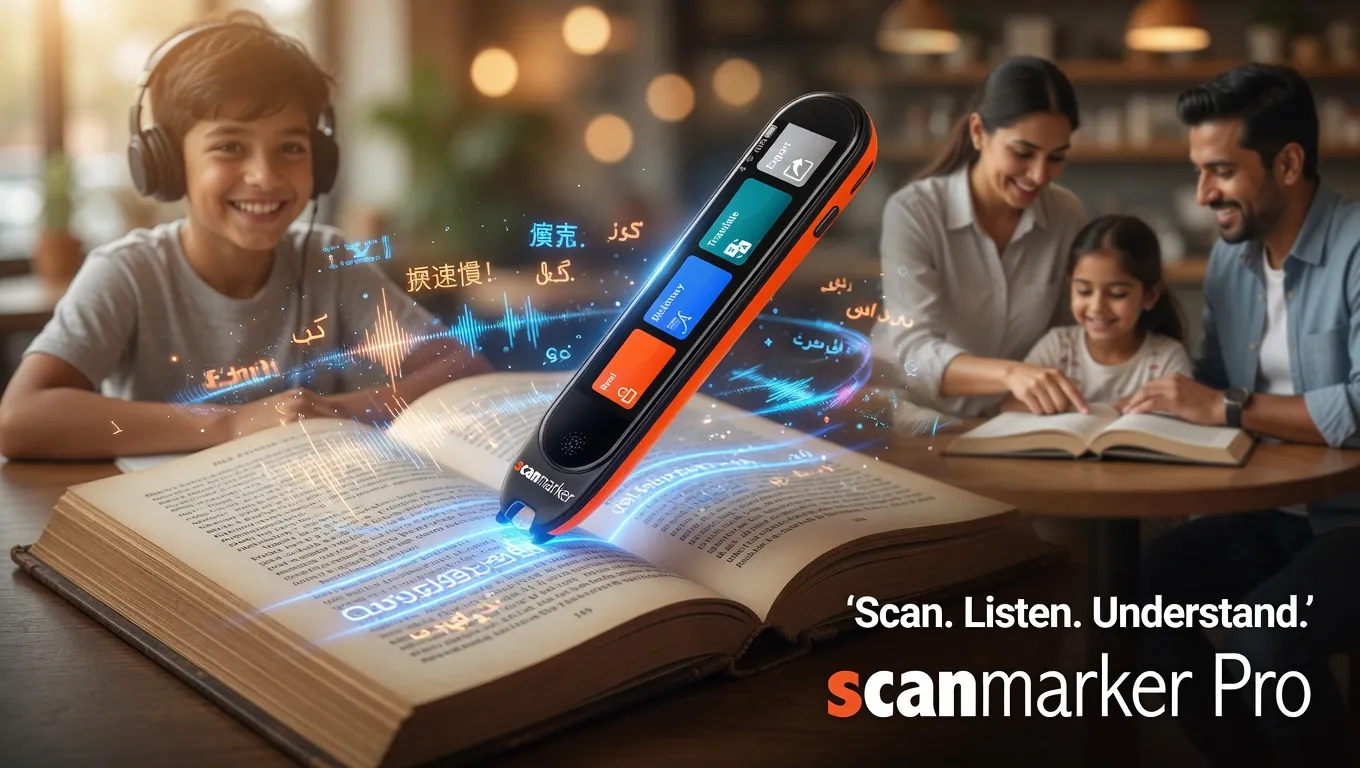
Scanmarker Pro — pairs with your phone or computer, includes the Collins English Dictionary, handles 100+ language translation. Best for research-heavy or multilingual work environments. Does require a phone or laptop nearby.
Scanmarker Max — fully standalone, no phone or laptop needed, works offline in any environment including client sites, field locations, or meeting rooms where phones aren't appropriate. Includes exam-lock mode (useful if you're also doing professional certification exams).
Neither requires disclosing a diagnosis to purchase or use. Both work with standard earphones for fully discreet use in a shared office.
See a full feature comparison at products/compare.
Frequently Asked Questions
Do I have to tell my employer I have dyslexia to get a reading pen?
No. You need to inform your employer that you have a medical condition that creates a functional limitation (specifically, difficulty reading printed documents) and request a specific accommodation for it. HR can ask for medical documentation confirming the limitation — they generally cannot require you to name the specific diagnosis in the request itself, and they cannot share your medical information with your manager without your consent.
What if my company says a reading pen is too expensive?
The legal standard for undue hardship considers cost relative to the employer's overall financial resources, not in absolute terms. For most employers, a $200–$300 device does not come close to meeting the undue hardship threshold. If an employer asserts undue hardship for this cost, contact the EEOC or a state civil rights agency — this is the kind of claim that doesn't hold up well under scrutiny.
Can I use my FSA or HSA to buy a reading pen for work?
Potentially yes. FSA/HSA eligibility for assistive technology requires that the device is used primarily to treat or alleviate a medical condition (dyslexia or ADHD, in this case). Keep documentation of the diagnosis to support the purchase if audited. Confirm with your plan administrator before purchasing.
My workplace only gives me digital documents. Do I still need a reading pen?
If everything you read at work is genuinely digital — no printed reports, no paper contracts, no physical meeting materials — then software like Microsoft Immersive Reader, a screen reader, or a text-to-speech browser extension may be more appropriate for your primary need, and your employer may be able to provide those at no cost. A reading pen's primary value is for physical printed material. See our comparison: Reading Pen vs. Microsoft Immersive Reader.
Can I use a reading pen during professional certification exams?
Many professional certification exams have accommodation processes for disability-related needs. Contact the exam authority directly with your documentation to request a read-aloud accommodation — they'll specify which devices or methods they permit. The Scanmarker Max's exam-lock mode (which disables Wi-Fi and translation) is designed to meet common exam authority requirements, but each authority has its own rules.
What if I'm self-employed?
The ADA applies to employers, not to self-employed individuals (you'd be both employer and employee, which makes the ADA inapplicable to yourself). However, the Access to Work scheme (UK) covers self-employed people, and HSA/FSA expenditure (US) is available regardless of employment status. Vocational Rehabilitation in the US can also support self-employed individuals under some circumstances.
Related reading: Reading Pens for Adults with Dyslexia · Reading Pens and ADHD: What Actually Helps · Who Pays for Reading Pens? IEP & 504 Guide · Compare Scanmarker Models
Tagged
- professionals
- workplace accommodations
- ADA
- dyslexia
- ADHD
- assistive technology
- adult
See the full solution
Scanmarker for Professionals
Need a pen for homework tonight — or a district quote?
