ADHD and reading difficulty are talked about together so often that people assume they're the same problem — or that anything designed to help a dyslexic reader will automatically help someone with ADHD. Neither is true.
The reading difficulty in ADHD is real, but it's different in nature. Understanding the difference is what makes the difference in whether a reading pen actually helps you — or your child — or whether it just sits in a drawer after a week.
This guide is for anyone with ADHD who's wondering whether a reading pen is worth trying, and for parents who are weighing it for a child. It's also for adults who've had a reading pen recommended for dyslexia and suspect something slightly different is going on.
ADHD and Reading — It's Not the Same Problem as Dyslexia
Why Decoding Isn't Usually the Issue
Dyslexia is primarily a decoding problem: the brain struggles to map letters to sounds, which makes sounding out unfamiliar words slow and unreliable. A reading pen solves that directly — it does the decoding for you.
ADHD is not primarily a decoding problem. Most people with ADHD can decode words accurately. They can read a sentence correctly. They can sometimes read a page correctly. What breaks down is what happens while the reading is happening and after it's done.
What Is the Issue: Attention, Working Memory, and the Wandering Eye
If you've ever read a full page and arrived at the bottom with no memory of what was on it, that's the ADHD reading experience in a sentence. The eyes moved across the line. The words were decoded. But somewhere between the words and the meaning, the mind was somewhere else entirely — replaying a conversation, noticing a sound in another room, or just... gone.
This is called attentional lapses during reading, and it's driven by two ADHD-related mechanisms that are worth understanding separately:
Attention dysregulation. ADHD affects the brain's ability to sustain directed attention on a task that isn't intrinsically stimulating. Silent reading of printed text — especially non-fiction — is one of the most attention-demanding, low-stimulation tasks a person can do. The brain's default-mode network (which is responsible for mind-wandering) tends to take over in exactly the gap where directed attention is supposed to be working.
Working memory limits. Reading comprehension requires holding information in working memory while new information arrives — the beginning of a sentence needs to stay active while you read the end of it. ADHD consistently impairs working memory capacity, which means longer or more complex sentences can drop information before the sentence is complete.
The practical result: an adult with ADHD can spend 45 minutes reading a 5-page report and finish with a vague sense of what it was about, having technically read every word.
How a Reading Pen Fits an ADHD Brain (Specifically)
A reading pen doesn't magically restore attention. But it does change the reading environment in ways that help with the specific mechanics of ADHD reading difficulty.
The Tactile Loop: Why Scanning Keeps Focus Anchored
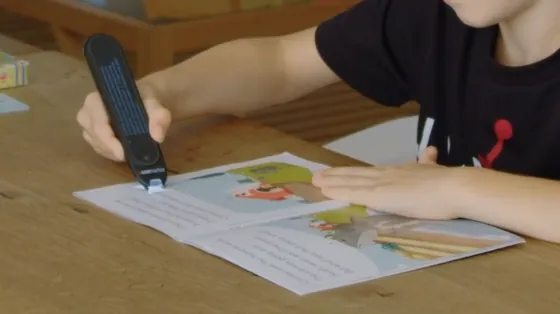
When you drag a reading pen across a line of text, you're not just capturing text — you're doing something with your hand. That physical action gives the ADHD brain a second input channel alongside reading: the sensation of the pen moving, the pressure of keeping it straight, the visual confirmation that the line is being scanned.
Many adults with ADHD find that this tactile engagement is the difference between sustained reading and continuous drift. It works for the same reason fidget tools help in meetings, or pacing while you think works better than sitting still: the motor engagement occupies the part of the brain that would otherwise wander, which frees the attention system to do its job.
Instant Feedback vs. the "I'll Look It Up Later" Trap
ADHD and the phrase "I'll do it later" have a complicated relationship. A person with ADHD who encounters an unfamiliar word or a confusing sentence is extremely likely to keep reading without resolving it, telling themselves they'll look it up later — and then not looking it up, because the impulse to do so has evaporated by the time they finish the paragraph.
A reading pen closes this loop immediately. Hear the word. Scan the word. Hear the definition or pronunciation. Move on. The resolution happens in the moment, not in a future that doesn't arrive.
Standalone vs. Phone-Based: Why the Device Matters More Than You'd Think
This is the part that most reading pen reviews miss when they're writing for an ADHD audience specifically.
If you use your phone as your text-to-speech tool — Google Lens, a screen reader, any read-aloud app — you are doing your reading on the same device that contains your texts, your notifications, your social media, and every other dopamine source your brain has ever discovered. The ADHD brain is not well-equipped to ignore these signals.
A standalone reading pen is a single-purpose device. There is no Instagram. There are no notifications. There is no browser. You scan text, you hear text, that's what it does. For many ADHD readers, this is the practical difference between actually finishing what they're reading and ending up somewhere else entirely.
The Scanmarker Max and Scanmarker PAL are fully standalone — no phone required. The Scanmarker Pro pairs with a phone or computer for its full feature set.
Where Reading Pens Work Best for ADHD
Physical Books and Print Worksheets
Printed material is where a reading pen is genuinely hard to replace. If you're reading a physical textbook, a worksheet, a printed article, or a paper-based test, the pen gives you immediate audio reinforcement without requiring you to pick up your phone or navigate any additional interface.
For children with ADHD in K-12 classrooms, where printed worksheets and physical books are still the primary learning medium, this is the most direct application.
Work Documents (Reports, Contracts, Printed Agendas)
For adults, the most common use case is document-heavy professional work: reading contracts before signing, reviewing reports before meetings, processing printed meeting materials in real time. A reading pen used with earphones is entirely discreet — it doesn't require telling anyone anything about your working style, your diagnosis, or your accommodations.
See our guide to reading pens at work for more on this use case.
Exam Settings — What the Rules Actually Say
If a child has an ADHD accommodation for extended time or read-aloud support, the reading pen may be eligible for use in testing — but this is set by the exam authority, not the school. The Scanmarker Max has an exam-lock mode that disables Wi-Fi and translation to meet common accommodation requirements.
Always confirm the specific exam authority's current policy before the day of the test. These rules change, they vary by state, and they're not always consistent between a district test and a state test and a college entrance exam.
What a Reading Pen Won't Fix
It's an Access Tool, Not a Focus Tool
A reading pen makes printed text accessible by converting it to audio. It does not treat the underlying attention regulation issue in ADHD — that's a separate clinical conversation involving behavioral strategies, medication, therapy, and executive function coaching.
If sustained attention is the primary barrier — if the problem is staying at the desk, not reading the text once you're there — a reading pen is one piece of a larger picture. It works best when attention is being managed through other means and the pen removes the additional friction of decoding and comprehension gaps.
Other Supports That Work Alongside It
- Structured reading breaks — reading in timed sprints (15–20 minutes) with intentional breaks tends to outperform trying to push through until exhaustion.
- Active note-taking while scanning — writing a word or phrase per paragraph after scanning it out loud reinforces retention through a separate output channel.
- Text-to-speech for digital content — Microsoft Immersive Reader handles digital text well; a reading pen handles printed text. Most ADHD readers eventually use both for different contexts. See our comparison: Reading Pen vs. Microsoft Immersive Reader.
- Working with an ADHD coach or therapist — executive function strategies specific to reading (like active reading protocols) address the attention layer that assistive technology can't reach. CHADD maintains a directory of ADHD coaches and clinicians.
Which PenScanner Model Makes Sense for ADHD?
The answer depends primarily on whether the reader is a child or adult and whether the print environment is a classroom or a desk.
| Situation | Recommended model | Why |
|---|---|---|
| Child in K-5 classroom | PAL ($179) | Designed for young / early readers; standalone; phonics support if co-occurring dyslexia is present |
| Student in middle or high school | Max ($299) | Standalone, exam-lock mode, touchscreen — one device from homework through standardized testing |
| Adult at work or in higher ed | Pro ($249) or Max | Pro for connected use with phone; Max if standalone no-phone environment is important |
| Adult who needs translation alongside read-aloud | Pro | 100+ language translation paired with Collins English Dictionary — strongest multilingual setup |
Not sure which fits? Take the three-question quiz on the homepage.
Frequently Asked Questions
Can a reading pen help an adult with ADHD who doesn't have dyslexia?
Yes. Adults with ADHD often have no difficulty decoding words but struggle to retain what they've read by the end of a page. A reading pen helps by delivering the content auditorily in real time, which creates a second input channel and can significantly improve retention. The tactile act of scanning also tends to keep attention anchored in a way that silent reading doesn't.
Is a reading pen better than a phone app for ADHD?
For printed material, yes — and for a specific reason that matters for ADHD specifically. Phone apps require unlocking your phone, which puts Instagram, notifications, and every other distraction one swipe away. A standalone reading pen is a single-purpose device with no distraction surface. That boundary is harder to maintain with an app than it sounds.
Will a reading pen be allowed in my ADHD accommodation during exams?
It depends on the exam authority and the specific device. The Scanmarker Max includes an exam-lock mode that disables Wi-Fi and translation to meet common accommodation rules. Always confirm directly with the testing body before the exam — these policies vary by state, by exam type, and change over time.
My child has both ADHD and dyslexia. Does a reading pen still make sense?
Frequently yes — co-occurring ADHD and dyslexia is common, with research suggesting 25–40% overlap between the two conditions. A reading pen addresses both the decoding barrier (dyslexia) and the retention loop (ADHD) simultaneously, making it a good fit for the overlapping case.
At what age can a child with ADHD start using a reading pen?
Most children can handle a reading pen physically around age 7–8, once they have enough fine motor control to drag the pen in a straight line. The PAL is designed for younger and struggling readers. The physical act of scanning — which many ADHD children find grounding — tends to make it easier for them to stay on task than purely software-based tools.
Is ADHD a disability that qualifies for read-aloud accommodations?
Yes, under IDEA in K-12 and Section 504/ADA in higher education and employment. ADHD can qualify as a disability when it substantially limits a major life activity — and reading comprehension clearly qualifies. For more on how reading accommodations work in school, see our IEP and 504 reading accommodations guide.
What's the difference between a reading pen and a screen reader for ADHD?
A screen reader (like NVDA or VoiceOver) works on digital text displayed on a screen. A reading pen works on physical printed text — books, worksheets, printed documents. If your reading is primarily digital, a screen reader or Immersive Reader may be more useful. If you're working with any printed material regularly, a reading pen fills the gap software can't.
The Bottom Line
A reading pen isn't a magic focus switch. But for ADHD readers dealing with physical printed material, it removes two of the biggest friction points at once: the decoding bottleneck that silently consumes working memory, and the reset cycle that kicks in every time the mind drifts mid-paragraph. For children in print-heavy classrooms and adults in document-heavy workplaces, those are real problems with a real hardware solution — one that works without a phone, without a notification in sight, and without anyone needing to know you're using it.
If you're comparing options, our full reading pen buyer's guide covers the main devices side by side. If you're deciding between models, the compare page has a feature-by-feature breakdown.
Related reading: How to Help a Struggling Reader at Home · Reading Pens for Adults with Dyslexia · Writing a Reading Pen Into an IEP or 504 Plan
Tagged
- ADHD
- assistive technology
- reading tools
- adults
- focus
- executive function
See the full solution
Scanmarker for Dyslexia & Reading Support
Need a pen for homework tonight — or a district quote?